
Hey Chicago!
This week we’re back with something more real estate-related since we often get questions about the different bungalow neighborhoods around the city.
In total, Chicago has more than 80,000 bungalows, roughly one-third of all single-family homes in the city. Most were built between 1910 and the early 1940’s, and follow roughly the same design: brick, one-and-a-half stories, a low-pitched roof, and a small front porch. If you look at a map of Chicago, they form a wide arc from the Northwest Side down through the Southwest and across the South Side, running about 4 – 7 miles out from downtown. This area is often known as the bungalow belt. It crosses dozens of neighborhoods, each with different histories, demographics, and price points.
If you’re a buyer looking at bungalows, they represent a significant share of the city’s owner-occupied housing, and bungalow neighborhoods tend to combine features that are difficult to find together at this price point: detached homes, private yards, transit access, and blocks established for decades. There are also city-backed preservation programs with financial incentives that affect both what buyers can be approved for and what they can do with the property after purchase.
If you haven’t met us yet, we’re the Ben Lalez Team. We’ve been helping people buy and sell all types of homes (not just bungalows) across Chicago for over a decade, and every week we write something about the city we think you’d find valuable or interesting.
What Is A Chicago Bungalow?
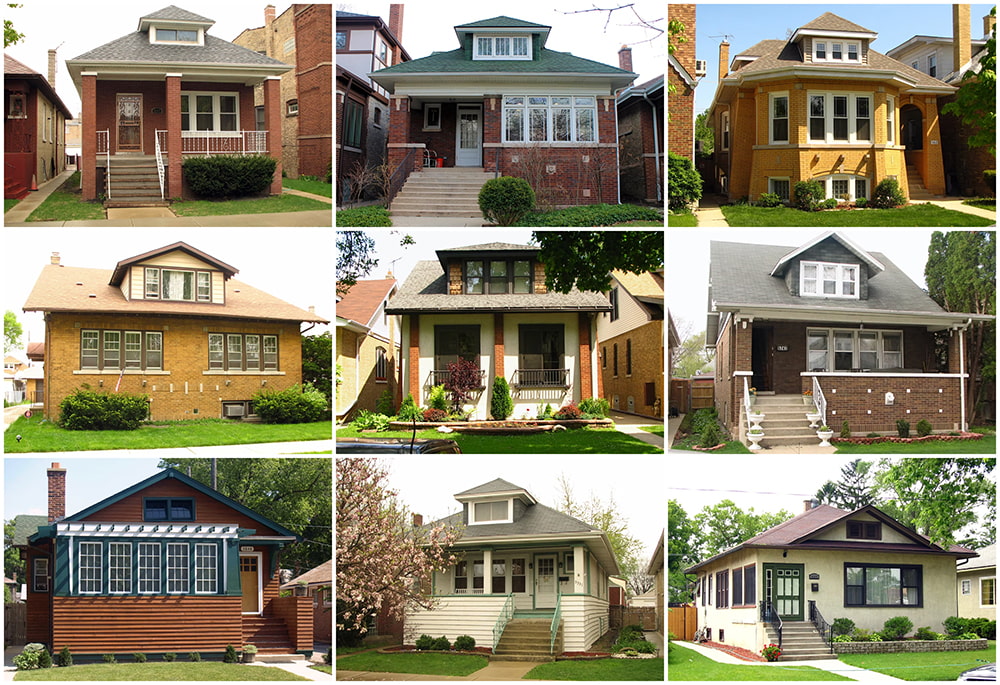
Across the bungalow belt, a typical Chicago bungalow sits on a narrow city lot, usually 25 feet wide by 125 feet deep. The house is one-and-a-half stories above a full basement, with a low-pitched hipped roof and wide eaves. On the street side, a porch steps up from the sidewalk, with a bank of large windows behind it and often a dormer in the roofline above to bring light into the upper floor. Almost all of them are brick.
The word “bungalow” didn’t start in Chicago. It came from a low, one-story house type used in British India and later adapted in California as an informal, arts-and-crafts-influenced house style. The adaptation that happened in Chicago had to solve narrow lots, tough winters, and buyers who needed something affordable in volume.
Where The Belt Runs
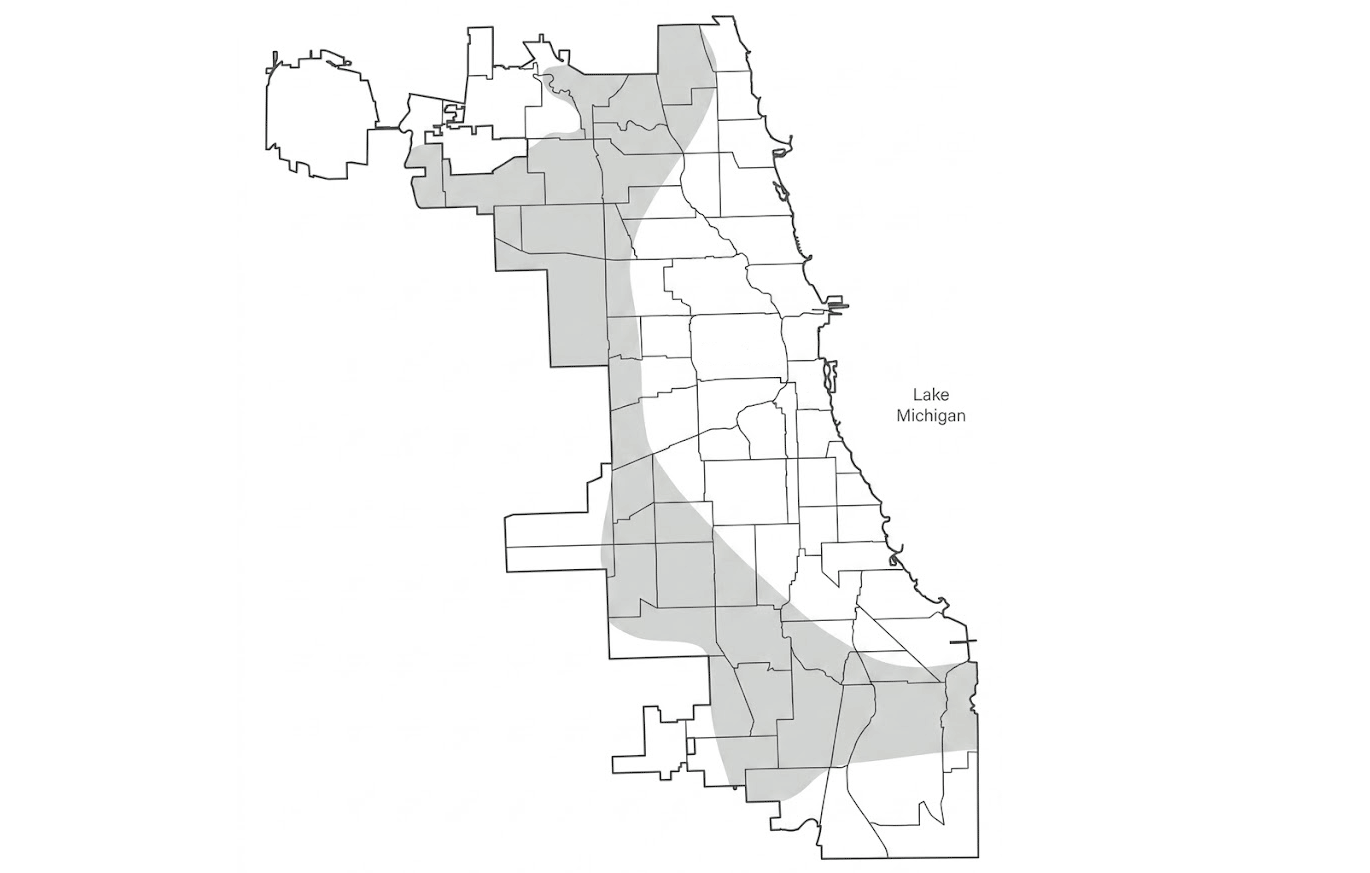
The belt covers a big portion of the city. On the Northwest Side, it runs through Portage Park, Jefferson Park, Norwood Park, Edgebrook, Belmont Cragin, and Avondale. In parts of this corridor, bungalows make up the majority of the residential housing stock.
The Southwest Side has the densest concentration: Bridgeport, Brighton Park, Marquette Park, West Lawn, Chicago Lawn, Gage Park, McKinley Park, and Archer Heights.
On the South Side, the belt continues through Chatham, Auburn Gresham, Greater Grand Crossing, South Shore, Calumet Heights, Beverly, and Morgan Park. Beverly stands out: the neighborhood is known for well-preserved bungalow blocks alongside larger Tudor-style homes, giving it unusual architectural variety for its location on the city’s southern edge.
The neighborhoods in the belt vary considerably in price, amenities, and transit access. Some are seeing renovation activity and buyer competition. Others are more stable and working-class.
How The Belt Was Built
To understand the belt today, we have to learn a bit of its history.
Between 1910 and 1930, the city saw more than a million people added to the population. Second-generation immigrant families were moving up economically and looking for houses of their own. Developers responded by buying farmland and open land at the city’s edges, subdividing it into narrow lots, and building bungalows in volume. The houses were priced between $2,500 and $10,000, depending on size and finish, and buyers obtained mortgages through building and loan associations.
By 1930, one-fourth of all residential structures in the Chicago metro area were less than 10 years old. The bungalow had become the dominant house type for working- and lower-middle-class buyers, to the point where nearly no other moderately priced house type was being built in the city.
Getting access to homes in this area back then wasn’t easy for some. Throughout the construction years and for decades after, African American families were systematically excluded from most bungalow belt neighborhoods through racially restrictive covenants written into property deeds, discriminatory lending practices, and federal housing policy that either condoned or actively reinforced both.
The Supreme Court ruled in Shelley v. Kraemer in 1948 that racially restrictive covenants were legally unenforceable, but discriminatory lending and other pressures continued long past that decision. When African American families did begin moving into belt neighborhoods, many white families left for the suburbs, reshaping large portions of the South and West sides of the city. Latino migration later transformed many Southwest and Northwest Side belt communities, adding another layer of demographic change to neighborhoods that had already gone through several.
Today, the belt’s demographics are a reflection of that history. Some neighborhoods in the arc are majority Latino. Others are majority Black. Others are mixed. A few have gentrified significantly in the past 15 years.
What You Find Inside
The floor plan of a Chicago bungalow is quite logical. The front of the house has a living room and a formal dining room that open into a single suite. Behind that are the kitchen and utility areas. Bedrooms are either along the main floor or in the half-story above the living space. The full basement adds storage and mechanical space that most comparably sized homes in other housing types don’t have.
Original interior finishes were influenced by the Arts and Crafts movement: varnished wood trim, built-in bookcases and cabinetry, glass-fronted cabinets, and leaded or art glass windows.
That era emphasized craftsmanship and materials with modern amenities: indoor plumbing, electricity, and central heating. For families moving out of older tenements where hot running water was not guaranteed, a bungalow with a full bathroom and a furnace represented a substantial change in daily living conditions.
We find that buyers who are specifically searching for bungalows really appreciate original details such as the woodwork, art glass, and built-ins. More recently, bungalow homeowners are redoing entire kitchens and bathrooms, redesigning basements, and finding creative ways to renovate their half-story spaces.
The Chicago Bungalow Association And Historic Designation
The city launched the Chicago Bungalow Initiative back in 2001 and created what is now the Chicago Bungalow Association, a nonprofit that provides educational resources, energy-efficiency programs, and design guidance for bungalow and vintage home owners. The Association has certified roughly 25,000 bungalows and has more than 15,000 members across the city.
At least 10 Bungalow Historic Districts have been established across the belt. Getting your home certified as a Historic Chicago Bungalow can qualify you for property tax incentives if you maintain and restore the house appropriately. This means keeping the original massing, rooflines, and window patterns, while allowing interior updates, mechanical improvements, and energy retrofits that don’t change the exterior character.
Although brick construction makes bungalows durable, their insulation and windows aren’t like those in modern homes. This is why the Association runs programs to help bungalow owners improve efficiency without replacing original materials that would detract from the home’s original spirit.
The Association also offers workshops, technical support, and case studies on updating kitchens, bathrooms, and structural spaces while preserving the original elements that give these houses their character.
For buyers considering a bungalow in a designated historic district, it’s important to know what review processes apply to exterior changes before closing. The tax incentives are worth having, but so is knowing what you’d need approval for before you start planning a renovation.
What Buyers Should Consider
Bungalow belt neighborhoods cover a wide price range. On the Northwest Side, Portage Park and Jefferson Park have seen steady buyer interest over the past several years, with bungalows in solid condition selling in the $350,000 to $500,000 range, depending on block and condition.
On the Southwest Side, comparable houses in Brighton Park and Marquette Park are usually a bit more affordable. Beverly on the South Side is a little bit different: the neighborhood’s architectural profile and preservation mean higher prices compared to the surrounding area.
Here are some things to know.
The basement configuration: some bungalow basements have been finished and used as living space, an in-law suite, or a separate rental unit. Others are unfinished storage. What the basement currently is, what it could legally become, and whether any existing improvements were permitted are all important to figure out before closing. Make sure to do your due diligence.
The half-story: the space above the main floor can be a functional bedroom with good ceiling height, or a low-ceilinged space that’s hard to use for anything. The dormer configuration and the roofline determine a lot of this, so we always recommend checking it out in person instead of just relying on photos you see online.
Historic designation: if the property is within a designated district or has been certified by the Chicago Bungalow Association, find out what that means for exterior modifications before you close. While there can be tax incentives, you will be limited by what you can do.
The lot: on a standard 25×125 foot lot, how much usable yard you have depends on how much of it the house occupies and where the garage sits. Detached garages in the alley are common, and their size and condition vary. Again, we recommend walking the property thoroughly to understand how you’re going to use that space.
Final Thoughts
For buyers working with a realistic budget, bungalows are a great option because they’re single-family homes that come with yards, basements, and detached garages.
We find that many of them come with modern, functional renovations that honor the bungalow design while maintaining the structure’s original character and history.
If you want to talk through specific belt neighborhoods, or would like to see properties anywhere in the bungalow belt, give us a shout! We’d love to help.
Until next week!